

Written Expression Assessment Tools
Written Expression Curriculum-Based Measurement (WE-CBM)
Research-validated WE-CBM story starters for universal screening and progress monitoring of written expression in Grades 2–6.
What Is WE-CBM?
Curriculum-Based Measurement for Written Expression
Written Expression Curriculum-Based Measurement (WE-CBM) is a brief, standardized assessment that provides reliable and valid data on students' general writing skills through Grades 5 or 6 and as a simple screener for older students. Students are given a story starter and write for a set time — typically 3 minutes — producing a writing sample with simple to obtain scores.
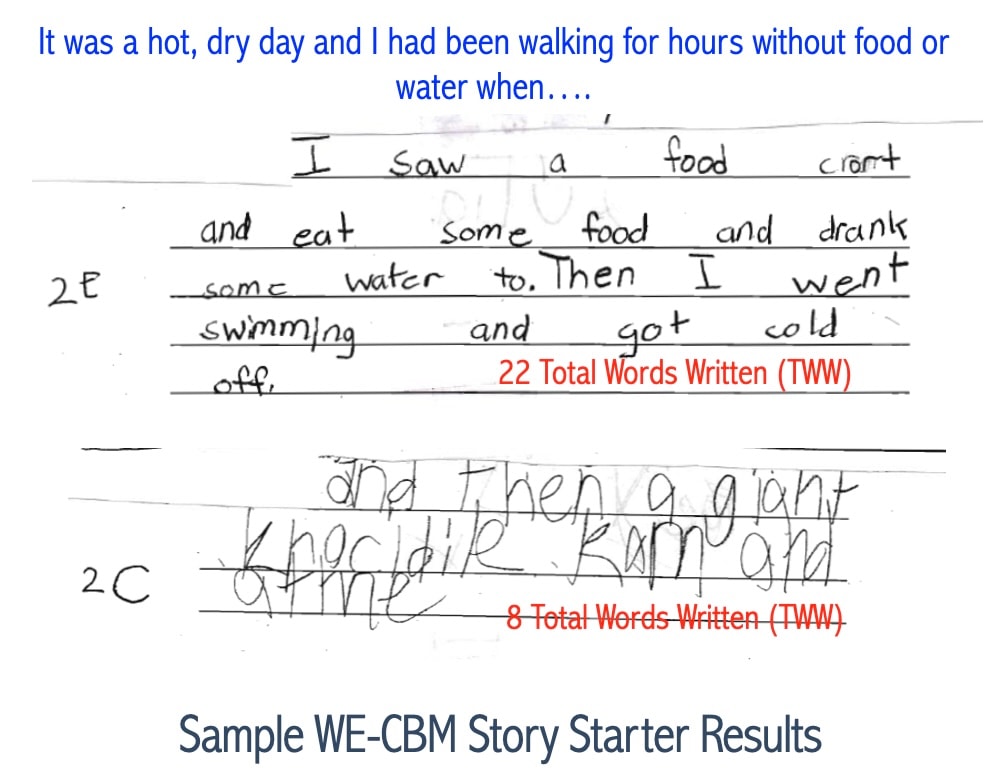
WE-CBM scores such as Total Words Written (TWW), Words Spelled Correctly (WSC), and Correct Writing Sequences (CWS) give educators a sensitive, repeatable measure of written expression growth. Like other CBM tools, WE-CBM is designed to be administered for students who receive writing interventions frequently, making it ideal for progress monitoring within a tiered support system.
Dr. Shinn's Grades 2–6 Story Starters for WE-CBM provide a ready-to-use set of standardized prompts aligned to research-based administration and scoring procedures.
Key Features
What Makes WE-CBM Different
Reliable & Valid
WE-CBM has an extensive research base demonstrating reliability when multiple samples (i.e., 3) are collected and validity for measuring written expression growth and identifying students at risk.
Grades 2–6
Story starters designed for use across Grades 2 through 6, with multiple forms available for universal screening and frequent progress monitoring.
Multiple Scoring Metrics
Supports Total Words Written (TWW), Words Spelled Correctly (WSC), and Correct Writing Sequences (CWS) for those students who are productive, but lack syntax and semantics— providing a rich picture of writing fluency and quality.
MTSS-Ready
Designed for use within a Multi-Tiered Systems of Support framework — from Tier 1 universal screening to Tier 3 intensive progress monitoring and IEP goal measurement.
Easy to Administer
Brief, group-administered format. Students write for 3 minutes from a story starter prompt. Minimal training required with clear, standardized scoring procedures.
Science of Reading Aligned
Consistent with Science of Reading principles — WE-CBM measures the written expression component of literacy, complementing reading and spelling CBM data.
How Schools Use WE-CBM
Four Ways Schools Put WE-CBM to Work
Universal Screening
Administer three times per year to identify students at risk for written expression difficulties before they fall significantly behind grade-level peers.
Progress Monitoring
Use three times per year as part of Benchmarking for growth and development or bi-weekly or monthly with students receiving Tier 2 or Tier 3 intervention to determine whether writing instruction is producing meaningful, measurable growth.
Special Education Eligibility
Provide objective, standardized data on written expression performance and progress to support or rule out Specific Learning Disability (SLD) identification under IDEA.
IEP Goal Setting
Write IEP goals and Tier 2/3 intervention targets grounded in reliable written expression data, with frequent progress monitoring to track growth toward benchmarks.
How to Order
Get the WE-CBM Story Starters
Available as a digital download — immediate access after purchase. Includes Story Starters for Grades 2–6 with administration and scoring guidance.
Grades 2–6 Story Starters for Written Expression CBM (WE-CBM)
$19.00
- Story starters for Grades 2–6
- Universal screening & progress monitoring
- Supports TWW, WSC, and CWS scoring
- Supports MTSS Tier 1, 2, and 3 decision-making
- Digital download — immediate access
Volume pricing available for districts & state agencies. Contact Dr. Shinn
Questions About WE-CBM or MTSS Implementation?
Dr. Shinn offers bespoke webinars and consultation on MTSS screening, progress monitoring, written expression assessment, and more.